Beware of “Recommended Brands”

If you’ve spent any time the reddit sub in r/redlighttherapy, you’ve probably seen redlightpicks.com come up.
The subreddit’s own description points readers there, and the mod describes the site’s list of
nine brands as “recommended products and vendors.” That’s a lot of trust resting on one page, so
we decided to actually read what those nine brands say about themselves, not the summary
blurbs on the picks page, but the real marketing copy on each brand’s own site: product pages,
FAQs, and blog posts.

A few housekeeping notes before the findings. First, the “Visit [Brand]” buttons on
redlightpicks.com route through affiliate tracking links (brands.lightpanels.info and similar),
and most listings feature a discount code tied to that link. That doesn’t make the
recommendations wrong, but it’s worth knowing the list is monetized before treating it as a
neutral consumer guide. Second, everything below is pulled directly from each brand’s own
website, in their own words, with the specific page it came from. We were not trying to relitigate
the medical literature on photobiomodulation. Instead, we were checking whether each brand’s claims are
hedged and cited, or asserted as flat fact with nothing behind them. We paid closest attention to
hair/balding and weight-loss claims specifically, since those are the two areas where “red light
therapy” marketing tends to run furthest ahead of what’s actually been shown in humans.

The short version: every brand except two makes both hair-growth and weight-loss claims, and in
nearly every case, the weight-loss claims are on shakier ground than the hair claims. Several
brands say one thing on the page where you’d actually click “buy,” and something noticeably more
cautious on a blog post three clicks away that most shoppers will never see.

WORST HAIR CLAIM: LightpathLED’s Therapy Cap product page headline reads “Regrow your Hair in
less than 6 months.” That’s it, just a specific, guaranteed-sounding outcome, on a specific timeline,
with zero citation attached anywhere on the page.

WORST-SOURCED HAIR CLAIM: Red Light Man’s hair-loss guide states plainly that light therapy has
“been shown in almost all studies to have a positive effect on hair loss.” We checked the raw
page source directly — there is not a single study, author, or link anywhere on that page. The
same article also recommends readers try self-dosing oral thyroid hormone to fight hair loss,
which has nothing to do with the light device being sold.

WORST WEIGHT-LOSS CLAIMS: Platinum LED (“Clinical research has also shown that red light therapy
can lead to weight loss,” “Yes, It Does” work for cellulite, “fast and effective fat loss”) and
Red Light Man (“your body will burn more calories,” “the size of the white fat cell decreases,”
stated as settled fact). Both cite real studies elsewhere on the page, but the studies mostly
measure a few inches of circumference lost over several weeks — not validated fat loss — and in
Red Light Man’s case, five of the six cited studies have no working link at all, so there’s no
way to check them from the page itself. Worth noting separately: the consumer watchdog
TruthInAdvertising.org has previously documented PlatinumLED displaying the FDA logo on its site
(which implies a federal endorsement that doesn’t exist for these devices) and being unable to
substantiate a “thousands of studies” claim when asked directly; the company removed the logo
after being contacted.

Brand by brand, briefly:

HOOGA HEALTH: The two hair product pages (HG Hat, ColorWave) claim the devices are “clinically
studied to support scalp health and encourage new hair growth” with no citation attached. Buried
in a separate blog post, Hooga actually cites a real 2021 meta-analysis and 2014 LaserComb trial
data, correctly scoped to mild-to-moderate androgenetic alopecia — good evidence that just isn’t
linked from the page where you’d actually buy the product. Weight-loss claims are weaker: the
“Enhances Fat Loss” bullet on the Learn page has no explanation at all, and the weight-loss blog
post’s “cells leak fat” mechanism is attributed only to unnamed “new research.”

RLT HOME: Lists “hair loss” and “weight loss” flatly as conditions its device treats, and even
names a device preset “Fat Burn & Weight Loss,” all backed by a vague claim of “2,600+ human
focused studies.” Read the company’s own blog, though, written by a named “Scientific Advisor,”
and it says the opposite: “insufficient high-quality clinical evidence” for fat loss, “results
vary” for hair. Also disclosed in fine print: the “2,600 studies” behind their wavelength charts
were summarized by an in-house AI tool, not an independent review.

EMR-TEK: Product pages are mostly scrubbed clean of health claims (specs only). All the hair
and weight-loss language lives in SEO blog posts that assert mechanisms as fact (“stimulate hair
follicles and encourage regrowth”) while citing zero named studies, the sources listed are a
skincare blog, a hair-drying guide, and a construction-industry website.

MITO RED LIGHT: The most careful brand in this list, and worth calling out for it. Its research
hub openly states: “Mito Red Light has not funded or conducted registered clinical trials on our
specific devices.” Its hair claims cite real, named human trials (Kim 2013, Lanzafame 2013/2014,
Jimenez 2014). Its weight-loss content is the most self-skeptical of any brand reviewed,
explicitly stating RLT “does not burn fat on its own” and reporting modest results (about two
pounds over six weeks in one cited study).

OMNILUX: Makes no hair claims and no weight-loss claims at all; it simply doesn’t sell products
in either category. It’s also the only brand with a real, currently registered human clinical
trial (NCT06936332, for acne) and a genuine bibliography page that’s honest about which citations
support an actual FDA-cleared indication and which don’t.

PLATINUM LED: See “worst weight-loss claims” above. Its hair-loss page mixes real cited
statistics (a 37% hair-growth increase from a named 2014 study) with an uncited claim that light
therapy “can reverse balding,” in a way that makes the whole page look more evidence-backed than
it is.

CHROMA: One of two brands making no weight-loss claims of any kind. Its hair claims are hedged
and cite real, specific studies, though. Those studies were run on
someone else’s device, not Chroma’s own Ironforge.

LIGHTPATHLED: See “worst hair claim” above. Its weight-loss content is a mixed bag: some hedged
language with real linked studies, alongside a line promising you’ll “supercharge your body’s
ability to shed fat during each workout.” No dedicated science or research page exists on the
site (we checked — /pages/science, /pages/research, and /pages/studies all 404).

RED LIGHT MAN: See “worst-sourced hair claim” and “worst weight-loss claims” above. What makes
this one interesting is the inconsistency: the same site’s Arthritis and Muscle Recovery articles
are the best-cited pages we found anywhere in this whole review, with 35 numbered references and
honest labeling of which studies were done in animals versus humans. The hair-loss and acne pages
have none of that rigor.

None of the nine brands used outright “cures baldness” or “guaranteed weight loss” language.
That’s a low bar, but it’s worth naming — this isn’t a story about outright scams. It’s a story
about a consistent pattern: confident claims at the point of sale, and much more careful,
hedged, sometimes outright contradictory language in the fine print or the blog post most
shoppers will never scroll to.

None of this means red light therapy “doesn’t work”. The pain/recovery and acne categories in
particular have real, named, human randomized trials behind them, from multiple brands. It means
the specific hair and weight-loss claims on this specific “recommended vendors” list deserve more
scrutiny than a five-star badge and a discount code usually invite.

If you want to dig into a brand’s claims yourself before buying or if you’ve already got a
device and want a second opinion on what it can realistically do for hair or weight loss, that’s
exactly the kind of discussion r/redlighttherapy101 exists for. We’d rather you walk in skeptical
and leave better informed than walk in convinced by a listicle. Come ask questions, bring a
product page you’re unsure about, and we’ll go through it together.
Red Reactive Review

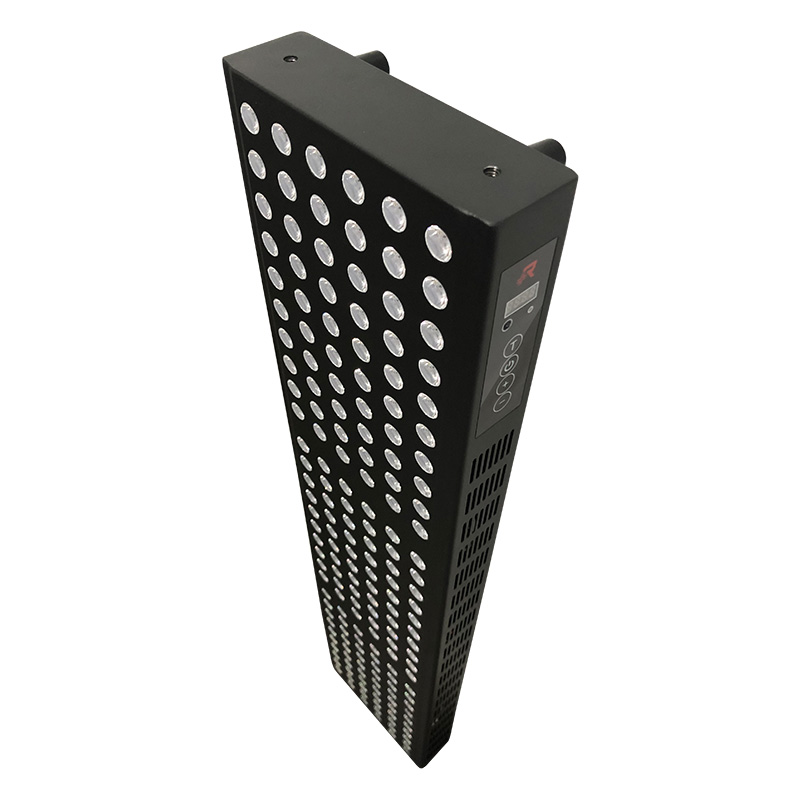
Red Reactive brings decades of proven experience in clinical settings to the at-home user in an elegant package. For this Red Reactive review, we’ll focus on the R3. It offers a wide range of settings to deliver a total wellness solution.

Quick take:

  • QuadraFluxTM technology emits four wavelengths: 633nm, 810nm, 850nm, and 940nm for shallow and deep penetration
  • Smart HzTM technology allows user to set a continuous wave or adjust the frequency of pulsing
  • Works right out of the box, no assembly or setup required
  • One of the higher-priced units; shipping not included
Red Reactive R3 is a high-end at-home red light therapy device that makes a wide range of shallow and deep tissue treatments possible.

Company Background

The Red Reactive website says that the founders and leadership team have decades of experience in photomedicine and biophotonics. For instance, the company claims to have partnered with the world’s top laser and light experts. The stated Red Reactive mission is to deliver products with cutting-edge design that offer the most powerful and effective red light therapy devices on the market.

Red Reactive is a sister company to Aspen Laser, a well-known and respected manufacturer of laser therapy devices that are sold to clinicians and used in clinical environments. So it is not a surprise that experts within the company were able to design and manufacture products for the at-home market.

Aspen Laser was awarded “Company of the Year” in the pain management category by MedTech Outlook magazine in 2020. Therefore, bonafides like these lend a substantial degree of credibility to the company’s efforts in the adjacent at-home category. We don’t have any experience with Aspen Laser products. We only covered the R1 and R3 products in this Red Reactive review.

Product Features & Benefits

The Red Reactive R3 is the company’s flagship at-home red light therapy device. Price of the R3 is $1,699. Naturally, the smaller R1 costs only $949.00.

The R3 has 180 Class 1 LEDs that irradiate 110mW/cm2. However, the company hasn’t specified the distance from the panel required to achieve that exposure.

The panel is 38 inches in length, 9 inches in width, and only 2.5 inches deep. Additionally, it weighs 35 pounds. Of course, a panel of this size is almost certainly intended for a stationary application. Accordingly, the company includes hardware to hang the unit over a door or near a wall.

Interestingly, the unit appears to be air-cooled. If this method is effective, then the Red Reactive could be one of the more quiet models on the market. For instance, this would be perfect for situations where roommates or spouses were trying to sleep.

Four Wavelength Settings: 633nm, 810nm, 850nm, 940nm

Most at-home red light and near-infrared therapy products offer two or three wavelength settings. But the Red Reactive R3 is different. It offers four wavelength settings. This is one of the most exciting features of the product. Longer wavelengths penetrate tissue deeper.

With so many wavelength settings available, the unit can be used treat a wide variety of conditions. To date, we haven’t seen a device with this many settings. Nor have we seen a product that offers the 940nm wavelength in a multi-mode configuration.

Continuous Wave vs. Variable Pulse

Pulsing therapy has been studied by the scientific community. Some studies imply that pulsed light keeps tissue temperature lower. Also, there are theories that mammalian brain activity exhibits wave-like behaviors. And so photoreceptors could be able to “catch” more light when the waves are in closer sync to the brain’s activity.

Finally, scientists have theorized that the charge of the ion matters for photon absorption.

Regardless, it is clear that with a nearly unlimited number of setting combinations, the Red Reactive R3, along with its smaller, more portable sibling R1, the user is afforded perhaps the best opportunity to experiment with the ideal at-home red light therapy for multiple conditions.

Check out a video of the pulse settings in action:

Red Reactive’s R3 at-home red light therapy device is the first one that we’ve reviewed with four wavelength settings as well as both continuous and pulse modes. As of this Red Reactive review, we haven’t come across a unit with this many configuration possibilities.

Specifications

  • FDA Class: Class 1
  • LED count: 180 LEDs
  • Wavelength(s): four settings: 633nm, 810nm, 850nm, 940nm
  • Irradiance: 110mW/cm2 
  • Pulse Rate: variable between 10 hertz and 500 hertz
  • Cooling: air cooled
  • Weight: 35 pounds
  • Dimensions: 38″ x 9″ x 2.5″
  • Power source: 110 volt AC

Accessories

Both the Red Reactive R1 and R3 come with the following accessories:

  • 110v AC power cable
  • User manual
  • Door hook
  • Hanging cables
  • Pulley for height adjustment

Warranty, Shipping, & Availability

No warranty information is provided on the Red Reactive website, although the company provides several methods of contact, including web, phone, email, and a physical mailing address.

Red Reactive ships only to the United States and Canada. Standard shipping costs $89.

We recommend products based on our independent research and consumer popularity. If you make a purchase through links on this page, we may earn a small commission at no extra cost to you. Learn more.

Mito Red Light Therapy Review

Mito Red Light Therapy products have established a credible brand and offer a sophisticated range of products to at-home users.

Quick take:

  • Wide range of panel-style product configurations
  • 60-degree beam angle delivers more power and effective irradiance
  • Customer-friendly shipping, return, financing, and warranty policy
The Mito Red Pro is brings together powerful red light therapy treatment at an accessible price.

Company Background

Based in Arizona, the Mito Red “biohacking” team has tried every health and wellness diet and gadget out there. Like you, the benefits of red light therapy interested the founders.

Accordingly, the team built affordable and effective red light therapy device options. They operate a “lean” business. For example, the company doesn’t spend money on lavish marketing campaigns. Nor does it seek celebrity endorsements. As a result, the customer saves money.

Mito Red was founded in 2019. Since then, the company launched three product lines to the US market. As you can see, the company targets wellness enthusiasts, such as athletes and fitness-minded individuals. One of the company’s photos shows a child receiving treatment. Accordingly, the company believes that its products are well-suited for families.

Product Features & Benefits

IMPORTANT PRICING UPDATE: Mito Red Light has provided us with their special sale pricing on the Original Series products. Use our links to see these great new prices.

The Mito Red Original Series includes four products. All of the products feature 5-watt LEDs. The LEDs boast a 60 degree beam angle. Also, all units have dual-mode 660nm red and 850nm near-infrared settings. Finally, the products receive glowing reviews from actual users.

Mito Red Light Therapy MitoMIN

MitoMIN is a 9-pound, portable Mito Red light therapy device. It is about the size of a laptop. Due to its size, it features dual-mode 660nm red and 850 near-infrared options across 60 LEDs that deliver more than 85mW/cm2 at 6 inches of distance. As a result, the MitoMIN delivers a respectable 14,503 Joules in 10 minutes. Of note, two rear-facing fans keep the unit at a reasonable temperature. Priced at just $299 (SALE! $239). The MitoMIN is affordable, yet powerful. Therefore, it is a solid choice for red light therapy newbies or occasional travelers.

The Mito Red Light Therapy MitoMID model is an affordable and convenient dual-mode device for first time users.
MitoMID, 500-Watt panel

Mito Red Light Therapy MitoMID

MitoMID is a 19″ x 9″ x 3″ mid-sized version of the MitoMIN. The MitoMID features 100 LEDs that deliver more than 100mW/cm2 at 6 inches of distance. Also, it weighs in at 9 pounds. Due to this size, stationary use in a single room of the house is the best location for the MitoMID. The MitoMID carries a price tag of $695 (SALE! $399).

Mito Red Light Therapy MitoMAX

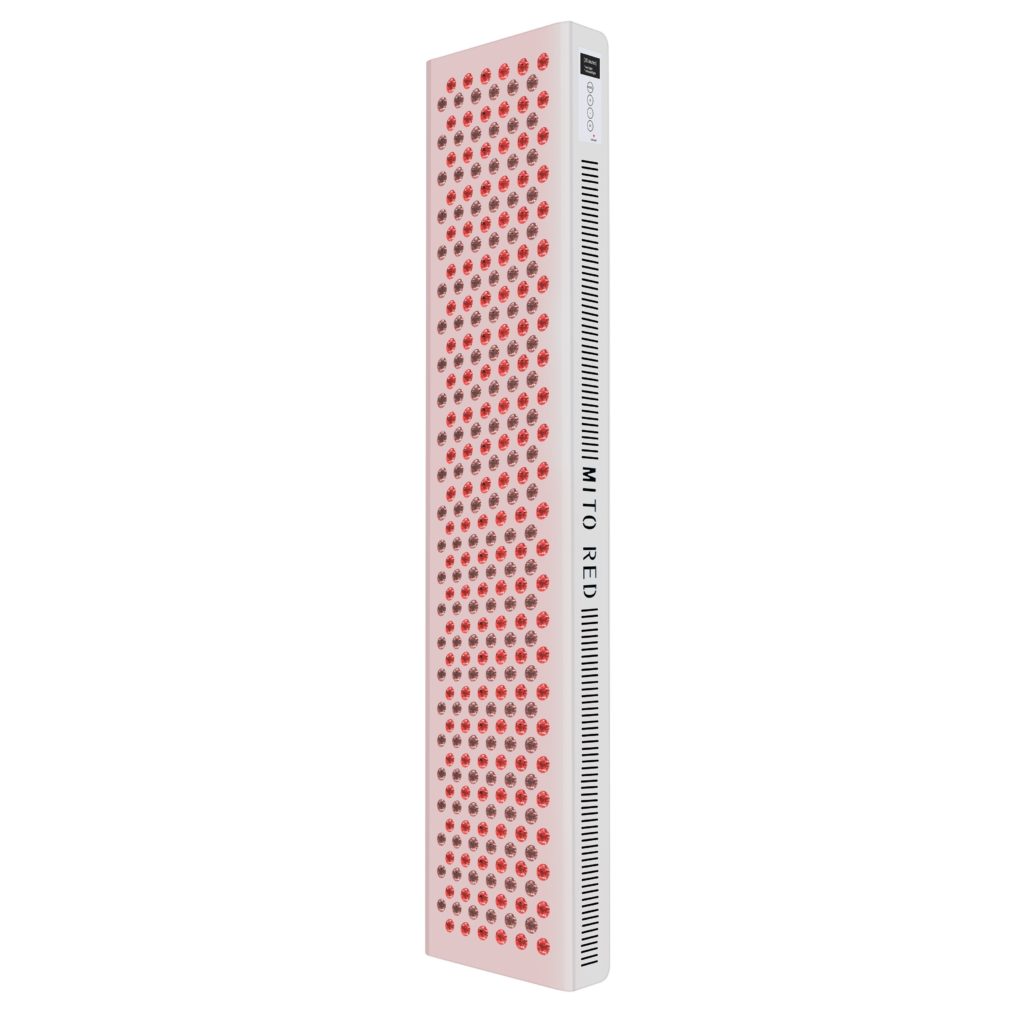
MitoMAX is the next size up in the Mito Red Light Original Series. Its dimensions are over three feet in height and 20 pounds in weight. The MitoMAX has an impressive 200 LEDs that generate over 110 mW/cm2 of irradiance at a 6 inch distance. As a result, this unit generates over 48,000 Joules in 10 minutes. Obviously, you will mostly like hang the MitoMAX from a door. The model will not easily fit on a surface. After all, a stand-mounted MitoMAX would take up more floor space than a typical urban dweller would be comfortable with. Four rear-mounted fans keep the unit cool. In terms of price, $1,195 (SALE! $695) is on par with similarly sized units in the market.

Mito Red Light Therapy MitoMEGA

Finally, the MitoMEGA is the largest panel to complete the Mito Red Original Series. The MitoMEGA adds an extra two columns to the LED array. As a result, the total number of LEDs in the panel to 300 and delivering an incredible 125 mW/cm2 in irradiance at 6 inches of distance. Accordingly, the MitoMEGA can deliver an impressive 72,500 Joules to exposed areas of the body over a 10-minute session. Finally, five rear-facing fans cool the unit. Priced at $2,195 (SALE! $999), this unit would be the choice for a powerful, full-body device at a reasonable price.

Accessories

Every product in the Mito Red Original Series includes a standard array of valuable accessories.

  • Power cord
  • Goggles
  • User Manual
  • Steel cable
  • Door hanging hook
  • Adjustable height pulley system

Warranty, Shipping, & Availability

Mito Red Light therapy company products are a safe purchase. For example, the company has objectively tested every product it offers. Typically, this is done through an independent third party. As you can see, the company publishes the test results on its website.

Mito Red Light claims that its products have a 50,000 hour lifespan. Accordingly, this equates to 274 years of daily 30 minute sessions.

The company offers a full 60 day trial period. However, return shipping must be paid by the buyer. Plus, every product includes a full, 2-year warranty.

We recommend products based on our independent research and consumer popularity. If you make a purchase through links on this page, we may earn a small commission at no extra cost to you. Learn more.